
























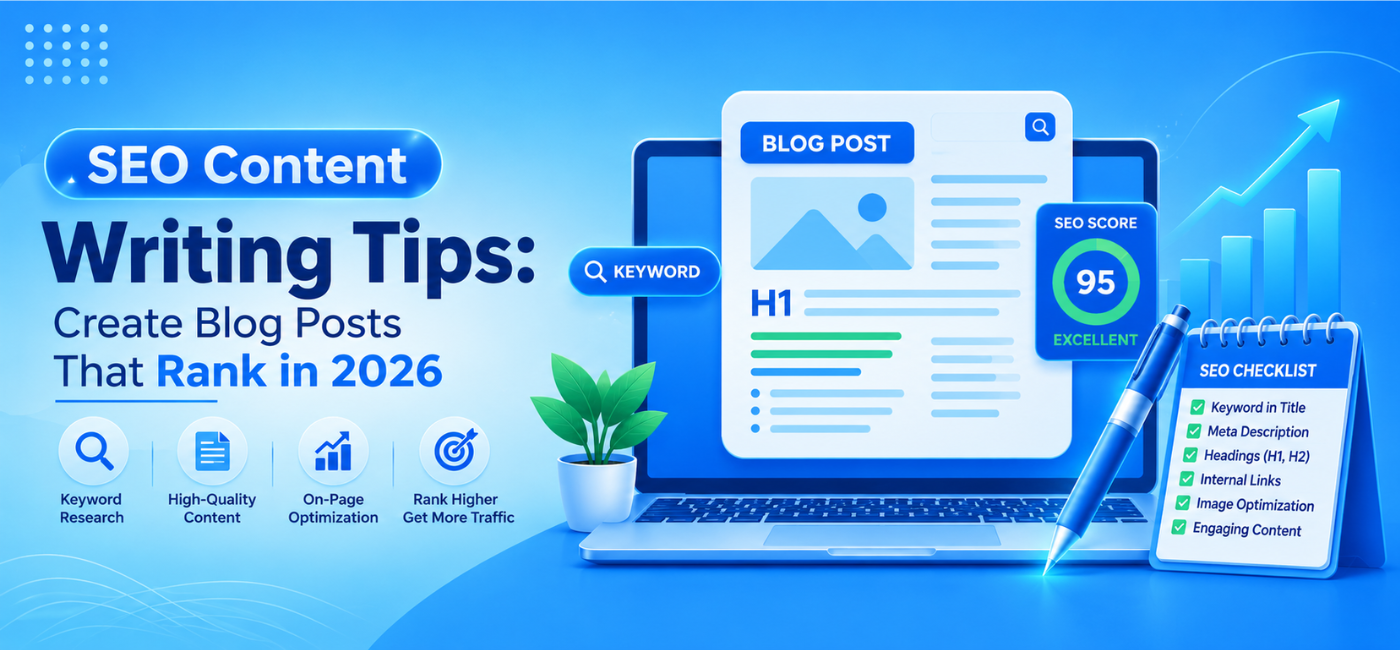
Writing a blog post is easy. Writing one that earns relevant Google visibility, helps a reader make a decision, and supports real business growth takes more planning.
The most effective SEO content writing tips begin with one important principle: write for the person behind the search, not just the keyword. A good article answers the question clearly, provides useful next steps, uses trustworthy information, and gives readers a reason to stay on your website.
In 2026, content does not rank simply because it contains a phrase several times. Search engines and AI-driven search experiences increasingly reward useful, original, well-structured material that satisfies the searcher’s need. That means businesses need content with real value—not generic paragraphs created only to fill a page.
This guide explains how to research, write, optimize, publish, and improve blog posts that can attract qualified organic traffic over time.
Table of Contents
- What is SEO content writing?
- Why content quality matters in 2026
- Start with search intent
- Choose the right keyword
- Research what is already ranking
- Create a clear content brief
- Write a stronger introduction
- Structure posts with headings
- Add original value and experience
- Use keywords naturally
- Improve titles and meta descriptions
- Add internal links
- Use external sources carefully
- Optimize images
- Add FAQs and schema
- Create conversion paths
- Edit before publishing
- Update older blog posts
- Common mistakes to avoid
- FAQs
- Conclusion and CTA
What Is SEO Content Writing?
SEO content writing is the process of creating website content that is useful for people and easy for search engines to understand.
It includes more than inserting keywords. It involves:
- Understanding what a user wants.
- Choosing an appropriate topic.
- Researching keywords.
- Structuring information clearly.
- Adding examples and expertise.
- Optimizing titles and headings.
- Linking to relevant pages.
- Improving user experience.
- Measuring results after publishing.
For example, a person searching “how much does SEO cost in India” needs a transparent pricing guide. They may not be satisfied by a broad article explaining what SEO means.
Good content starts with matching the format and depth of the page to the intent behind the search.
Why Content Quality Matters in 2026
Search engines want to recommend pages that are useful, original, and relevant to the query. Google’s guidance on generative AI optimization emphasizes valuable, unique, non-commodity content rather than content that simply repeats what already exists online.
The strongest articles tend to share several qualities:
- They answer the main question early.
- They provide practical details.
- They are easy to scan.
- They include clear headings.
- They use examples.
- They show experience and subject knowledge.
- They link to related resources.
- They are updated when information changes.
- They guide readers toward a logical next step.
A blog post does not need to be the longest page on Google. It needs to be one of the most helpful pages for the specific person searching.
Start With Search Intent
Search intent is the reason someone performs a search. Before writing, identify whether a person wants to learn, compare, buy, visit, or solve a problem.
The four main types of search intent are:
| Search intent | What the user wants | Example query | Best content format |
| Informational | Learn something | “What is local SEO?” | Guide, explainer, checklist |
| Commercial investigation | Compare options | “Best SEO agency in India” | Comparison, pricing guide, review |
| Transactional | Take action | “Hire SEO agency” | Service page, booking page |
| Navigational | Find a website or brand | “NP Creations SEO services” | Brand or service page |
Before writing, search the target phrase and review the first-page results. Look at the content format, titles, headings, depth, and questions covered. This helps you understand what Google has already identified as useful for that query.
For a keyword such as “SEO content writing tips,” readers usually expect an educational list of actionable recommendations, not a short sales page.
Choose One Main Keyword
Every article should have one clear primary keyword or central topic. This gives your content focus and helps you avoid writing a vague post that tries to cover too many unrelated subjects.
Your primary phrase should appear naturally in:
- SEO title.
- Meta title.
- Meta description.
- URL slug.
- H1.
- Introduction.
- At least one subheading where relevant.
- A related FAQ.
However, do not force the keyword into every paragraph. Keyword stuffing makes content less readable and can make a page look low quality.
Instead, cover closely related language naturally. For this topic, relevant terms may include:
- SEO writing
- content optimization
- keyword research
- search intent
- on-page SEO
- content marketing strategy
- blog writing for SEO
- internal linking
- SEO-friendly content
The aim is topic coverage, not repetition.
Research What Is Already Ranking
Competitor research does not mean copying other articles. It helps you identify the questions, formats, and information gaps that matter to searchers.
When reviewing top-ranking pages, look for:
- Common headings.
- Content length and depth.
- FAQ topics.
- Tools or templates mentioned.
- Examples used.
- Missing details.
- Outdated information.
- Weak explanations.
- Opportunities to add your own experience.
A useful question is: “What would make this article more practical for my audience than the pages already ranking?”
For example, if competitors explain internal linking but do not show how to choose relevant anchor text, your article can add a simple before-and-after example.
Create a Clear Content Brief
A content brief helps writers, editors, and subject experts create an article with purpose. It reduces rewrites and keeps the post aligned with search intent.
A simple brief should include:
| Brief element | What to define |
| Target keyword | Main phrase or topic |
| Search intent | Informational, commercial, transactional, or navigational |
| Target audience | Who will read the article |
| Main objective | Traffic, leads, education, conversions, or authority |
| Reader problem | What they want help with |
| Key sections | Headings and questions to cover |
| Internal links | Relevant services and related blogs |
| Call to action | What readers should do next |
| Sources | Trusted sources and expert inputs |
| Update date | When to review the content again |
A good brief also clarifies what the article should not do. For example, do not make unsupported ranking promises, reuse generic AI copy, or overstate results.
Write an Introduction That Answers the Question
Your introduction should make readers feel that they have reached the right page. Avoid long, vague openings that take several paragraphs to reach the topic.
A strong introduction usually does three things:
- Identifies the reader’s problem.
- Gives a direct answer or useful context.
- Explains what the article will cover.
Weak example
“Content has become very important in today’s digital world. Every business needs content to grow online.”
This is broad and does not answer a real question.
Stronger example
“SEO content writing helps businesses attract visitors who are actively searching for answers, products, or services. To rank in 2026, a blog post needs to match search intent, explain the topic clearly, and offer more value than a generic summary.”
The second version is clearer, more specific, and more useful.
Structure Content With Clear Headings
Headings make long posts easier to read. They also help search engines and AI systems understand the relationship between ideas.
Use a logical structure:
- H1 for the main topic.
- H2 for major sections.
- H3 for supporting points within a section.
- Bullet points for scannable details.
- Tables for comparisons.
- FAQs for common questions.
Avoid using headings only for design. Every heading should describe the content beneath it.
A clear structure also makes your content easier to extract for answer-focused search experiences. 2026 SEO guidance increasingly recommends direct answers, organized sections, and schema where appropriate so content can be understood and surfaced more easily.
Add Original Value and Experience
The web does not need another article that repeats the same ten generic tips. Your content should include useful details gained from real work, customer questions, testing, or industry experience.
Add value through:
- Practical examples.
- Checklists.
- Templates.
- Frameworks.
- Original observations.
- Case-study insights.
- Before-and-after examples.
- Common mistakes.
- Decision-making advice.
- Data from your own processes.
For example, instead of simply saying “write better meta descriptions,” explain that a service business could write a description that includes the service, target location, benefit, and next step.
Example
Generic version:
“Use internal links in your content.”
Helpful version:
“An article about local SEO can link to a local SEO service page using a descriptive anchor such as ‘local SEO services for business growth.’ This gives readers a relevant next step and helps search engines understand the relationship between the guide and the service.”
NP Creations’ local SEO services page is a relevant destination for content discussing local business visibility, map rankings, and location-focused search growth.
Use Keywords Naturally
Keywords still matter because they help clarify topic relevance. But using a phrase repeatedly does not make an article more helpful.
Use the primary keyword in important locations, then write naturally using related concepts and language.
Better keyword usage
Instead of repeating the same phrase, use variations based on context:
- SEO writing process.
- Search-optimized blog post.
- Content optimization methods.
- Writing for search intent.
- Organic content strategy.
- On-page content improvements.
The page should feel written for a human reader. If a keyword feels unnatural in a sentence, rewrite the sentence rather than forcing it in.
Optimize SEO Titles and Meta Descriptions
Your SEO title and meta description are often a person’s first interaction with your content in the search results.
SEO title checklist
- Include the primary topic naturally.
- Make the benefit clear.
- Use a number or year only when helpful.
- Avoid vague clickbait.
- Keep the promise aligned with the page.
Meta description checklist
- Explain what the reader will learn.
- Include the topic naturally.
- Use clear, active language.
- Give users a reason to click.
- Avoid making claims the article cannot support.
Example
SEO title: SEO Content Writing Tips: Create Blog Posts That Rank in 2026
Meta description: Learn practical SEO content writing tips for 2026, including search intent, keyword research, headings, internal links, optimization, and content updates.
Your title should attract the right visitor, not every visitor.
Add Contextual Internal Links
Internal links guide readers to relevant pages on your website. They also show search engines how your content is organized.
Use links when they genuinely improve the reader experience. The anchor text should explain where the reader will go.
Good internal-linking practices include:
- Linking blog posts to closely related service pages.
- Linking supporting articles to pillar guides.
- Linking service pages to useful supporting resources.
- Using descriptive anchor text.
- Avoiding vague anchors such as “click here.”
- Avoiding unnecessary links in every sentence.
- Checking that every important page has internal links pointing to it.
SEO writing resources commonly recommend natural, descriptive internal links that connect supporting content with central service or pillar pages.
For a business writing about AI-assisted content workflows, a contextual link to NP Creations’ AI SEO services would be useful because the service page discusses AI-driven SEO strategies for visibility, qualified traffic, and conversions.
Use Trusted External Sources Carefully
External links can add credibility when they point to relevant, reliable, and useful sources.
Good external sources include:
- Google documentation.
- Government websites.
- Industry research.
- Original studies.
- Recognized expert publications.
- Official product documentation.
Avoid linking to weak sources simply to add more links. Every source should support a statement, clarify a concept, or give readers a practical resource.
When you use statistics, include the source and publication date where possible. If data is old, uncertain, or market-specific, make that clear.
Optimize Blog Images
Images improve readability and can help explain a process, comparison, or example. But they should not slow down the page.
Image optimization checklist
- Use descriptive filenames.
- Compress images before upload.
- Use WebP or AVIF where supported.
- Add useful alt text.
- Use captions when they add context.
- Avoid placing important text only inside an image.
- Use images that support the article.
- Check mobile display.
Example
Weak filename:
image-01-final-new.jpg
Better filename:
seo-content-writing-tips-2026.jpg
Weak alt text:
“SEO image”
Better alt text:
“SEO content writing checklist showing keyword research, search intent, headings, and internal linking”
Alt text should describe the image for users who cannot see it. It should not be a place to repeat keywords unnecessarily.
Add FAQs and Schema
FAQs can help you address quick questions that do not fit naturally into the main body. They are especially useful for definitions, comparisons, common concerns, and next-step questions.
For this topic, useful FAQs may include:
- How long should an SEO blog post be?
- How many keywords should I use?
- Can AI write SEO content?
- How often should I update blog posts?
- Do internal links help SEO?
- What makes content helpful?
FAQ schema can help search engines understand the question-and-answer structure. However, schema is not a guarantee that Google will show rich results.
Use schema only when the visible page includes the same questions and answers.
Create a Conversion Path
A blog post should help the reader, but it can also guide them to the next logical action.
Possible calls to action include:
- Read a related guide.
- Download a checklist.
- Request an SEO audit.
- Book a consultation.
- Explore a related service.
- Subscribe for updates.
- View case studies.
- Contact your team.
Match the CTA to the reader’s stage. A beginner searching for writing tips may want a checklist. A marketing manager researching content strategy may be ready to discuss a service.
For businesses that want content, SEO, PPC, and conversion tracking to work together, NP Creations’ performance marketing services cover measurable digital marketing channels and tactics.
Edit Before Publishing
Editing is where a good draft becomes a useful article.
Before publishing, check:
Content quality
- Does the article answer the main question?
- Is every section relevant?
- Are there practical examples?
- Is the language simple and natural?
- Is the advice accurate?
- Is there any unnecessary repetition?
On-page SEO
- Is the title clear?
- Is there one H1?
- Are H2s logical?
- Is the primary keyword used naturally?
- Are related terms included naturally?
- Are meta details complete?
- Are images optimized?
- Are internal links relevant?
User experience
- Is the content easy to scan?
- Are paragraphs short?
- Are tables readable on mobile?
- Is the call to action visible?
- Do links work?
- Are forms easy to complete?
A final human review is important even when AI tools support research, outlining, or editing. AI can speed up parts of the workflow, but expert experience and fact-checking are necessary to ensure usefulness, accuracy, and a genuine brand voice.
Update Older Blog Posts
SEO content should not be published and forgotten. Older posts may become outdated, lose rankings, or miss new customer questions.
Review content regularly for:
- Outdated dates.
- Changed pricing.
- Broken links.
- New competitor content.
- Search-intent shifts.
- Missing sections.
- Declining clicks.
- Low click-through rates.
- New products or services.
- New internal-linking opportunities.
A practical schedule is to review important articles every three to six months, while time-sensitive pages may need more frequent checks.
Content refreshing can be as simple as improving the introduction, adding a new section, updating examples, fixing links, or adding new FAQs.
Common SEO Content Writing Mistakes
Writing without understanding intent
A well-written article can still fail if the format does not match what users expect.
Repeating the same keyword
Keyword stuffing makes content awkward. Write clearly and use related concepts naturally.
Publishing generic AI-generated drafts
AI can help with research and drafting, but articles need human expertise, examples, fact-checking, and editing.
Ignoring commercial pages
Blogs alone may not generate leads. Support content with strong service pages, case studies, pricing pages, and conversion paths.
Using weak headings
Headings should help people and search engines understand the article structure.
Forgetting internal links
Relevant internal links help readers discover services and related resources.
Not updating content
Older content can lose usefulness and visibility when information, competitors, or search behavior change.
Conclusion
SEO content writing is not about tricking a search engine. It is about creating the most helpful, organized, and trustworthy answer for a specific search query.
The best blog posts start with user intent, use clear structure, add original insight, and provide a logical next step. They are optimized carefully, internally connected to relevant pages, and updated when information changes.
Use these SEO content writing tips to create content that serves your audience first. When visitors find your articles useful, search visibility, trust, and business opportunities can grow naturally over time.
Frequently Asked Questions
1. What are the best SEO content writing tips for beginners?
Start by understanding the search intent, choosing one clear keyword topic, reviewing the pages already ranking, creating a helpful outline, using logical headings, adding practical examples, and linking to relevant pages on your website.
2. How many times should I use a keyword in a blog post?
There is no fixed number. Use the keyword naturally in key areas such as the title, introduction, headings where relevant, and metadata. Focus on topic coverage and clarity instead of repetition.
3. Does AI-generated content rank on Google?
AI-assisted content can perform well when it is accurate, genuinely useful, original, and reviewed by a knowledgeable human. Generic, unedited, repetitive content is less likely to satisfy readers or perform consistently.
4. How long should an SEO blog post be?
The right length depends on the search intent and the depth needed to answer the question. A post should be as long as necessary to be useful, without adding filler.
5. Are internal links important for blog SEO?
Yes. Relevant internal links help users explore related information and help search engines understand how pages on your website connect.
6. Should I add FAQs to every blog post?
Not necessarily. Add FAQs when they answer real questions that are useful but do not fit naturally into the main content.
7. How often should SEO content be updated?
Review priority articles every three to six months. Update sooner when pricing, product details, regulations, trends, or search behavior change.
Call to Action
Need content that supports rankings, leads, and long-term organic growth? Explore NP Creations’ AI SEO services for strategic keyword research, content planning, technical optimization, and performance-focused SEO support.
You can also browse the NP Creations digital marketing and SEO blog for more practical insights on SEO, PPC, web development, and online growth.