



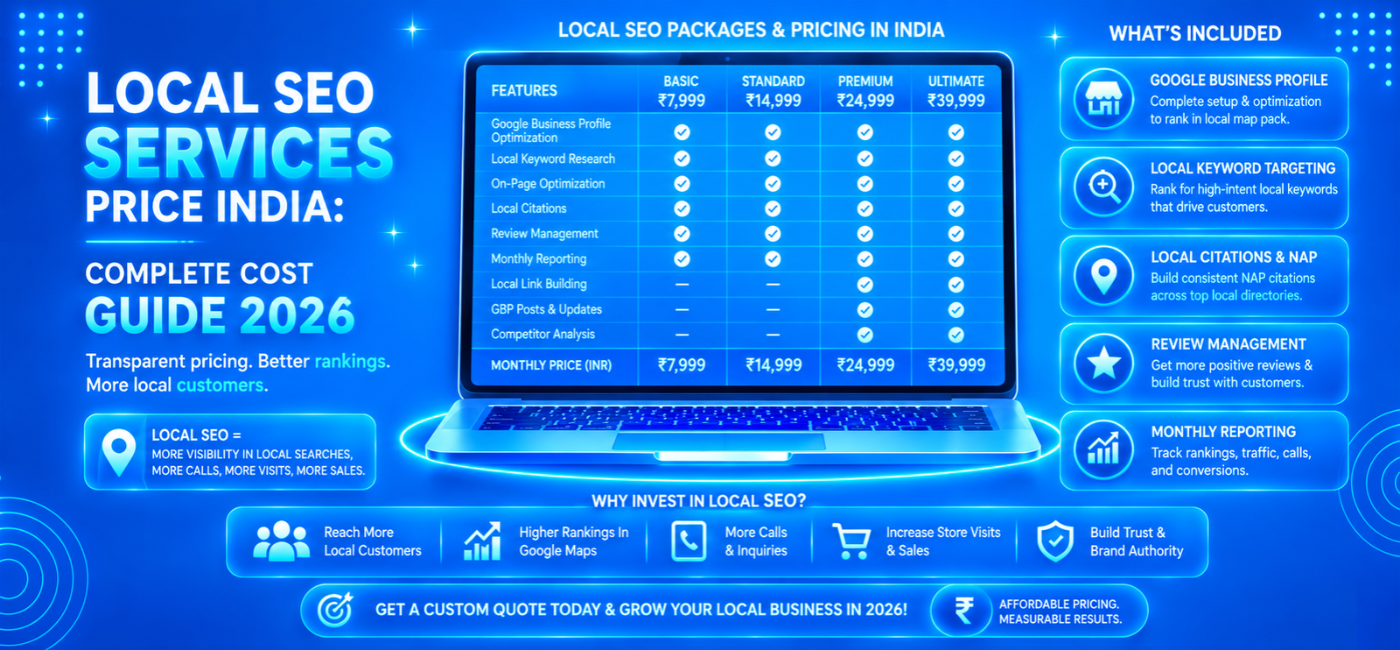
For a single-location business in India, a practical starting budget is around ₹8,000–₹25,000 per month for ongoing local SEO. Broader campaigns that include website improvements, content, competitive research, and lead tracking may cost ₹15,000–₹40,000 or more. These are planning ranges, not fixed industry rates.
If you are researching Local SEO services price India, the biggest challenge is comparing packages that sound similar but contain very different work.
One provider may only update your Google Business Profile. Another may improve your website, clean up business listings, support review requests, create location pages, and track qualified enquiries.
This guide explains what those differences mean, what you should expect to pay, and how to choose a package that fits your business.
Table of Contents
- How much does local SEO cost in India?
- Profile management versus a complete campaign
- What changes your monthly quote?
- What should a package include?
- One-time setup versus ongoing management
- Freelancer, agency, or in-house?
- Hidden costs to check
- How to compare proposals
- Measuring return on investment
- What to expect during the first 90 days
- Frequently asked questions
- Conclusion and next step
How Much Does Local SEO Cost in India in 2026?
There is no official rate card. Published prices vary substantially because providers bundle different services.
For example, one specialist advertises profile-focused management at ₹3,600 per month, while another provider lists local packages from ₹28,000 to ₹95,000 monthly. Those prices should not be treated as equivalent offers: the included work, target customers, and delivery models differ.
Use the following table to frame your budget.
| Service scope | Indicative monthly budget | What to clarify before buying |
| Profile-focused management | Approximately ₹3,000–₹8,000 | Whether website work, citations, and content are excluded |
| Single-location local campaign | Approximately ₹8,000–₹25,000 | Profile work, local pages, listing accuracy, and reporting |
| Broader or competitive single-location campaign | Approximately ₹15,000–₹40,000+ | Technical fixes, content production, implementation, and conversion tracking |
| Multi-location or complex campaign | Custom quote | Per-location work, shared tasks, content requirements, and reporting |
These bands summarize published provider examples and pricing guides; they are not a market-wide average. A lower quote may cover a narrower service rather than represent better value.
The useful question is: “What will be completed each month, and how does that work address my current problems
Profile Management Is Not the Same as Complete Local SEO
This distinction explains many confusing price differences.
Google Business Profile management
A profile-focused service may include:
- Checking business information.
- Updating hours and services.
- Publishing relevant updates.
- Uploading business-supplied photographs.
- Responding to reviews under an agreed process.
- Monitoring profile changes.
- Reporting available performance data.
This can suit a business whose website and wider online presence are already in good condition.
A complete local campaign
A broader service may also include:
- Local keyword research.
- Competitor analysis.
- Service-page improvements.
- Location-page content.
- Technical website fixes.
- Business-listing cleanup.
- Internal linking.
- Local outreach.
- Enquiry tracking.
- Conversion improvements.
NP Creations local SEO services describe a combined approach covering business profiles, local keywords, location-focused content, citation consistency, and performance tracking. The page does not publish a fixed package price, so the figures in this guide should not be interpreted as NP Creations quotations.
Before comparing two quotes, check whether both providers are proposing the same scope.
What Changes Your Monthly Quote?
1. Your starting point
A business with an accurate profile, a useful website, and consistent contact details needs different work from a business with duplicate listings, outdated numbers, and missing service pages.
Ask for an initial diagnosis. Otherwise, you may pay for recurring activities while the underlying problem remains unresolved.
2. Your location and competition
Competition depends on the specific service and search area—not simply whether you operate in a metro or smaller city.
A clinic in a competitive neighbourhood may require deeper page improvements and stronger local credibility than a niche repair service with few nearby competitors. Published India pricing guides identify location and competitiveness as important cost drivers.n
3. Your service range
A business offering one service has fewer page requirements than a clinic with multiple specialties or an agency offering several distinct services.
However, creating a page for every keyword variation is not automatically useful. The proposed page structure should reflect genuinely different customer needs.
4. Your number of locations
Multiple branches introduce additional work:
- Separate business-information checks.
- Location-specific content.
- Branch-level review processes.
- Distinct conversion tracking.
- Reporting by location.
- Coordination with local teams.
Some tasks can be shared, so five locations do not necessarily require five completely separate campaigns. Ask which costs are central and which recur per branch.
5. Content and implementation
“Recommendations included” is different from “changes implemented.”
Confirm who will write the pages, upload the content, edit templates, fix technical problems, and approve changes. A proposal can look inexpensive because execution is left to your team.
What Should a Local SEO Package Include?
A useful package should explain deliverables in plain English.
| Workstream | Examples of meaningful deliverables |
| Initial assessment | Website, business profile, competitors, listings, and tracking review |
| Business profile | Information checks, relevant categories, services, photographs, and updates |
| Website optimization | Priority service pages, titles, internal links, and contact paths |
| Location content | Useful pages for genuine branches or service areas |
| Business listings | Relevant listing checks, correction requests, and duplicate investigation |
| Review support | Honest request process and approved response guidelines |
| Measurement | Enquiries, calls where measurable, bookings, and completed work |
| Ongoing improvement | Actions based on performance and business changes |
Ask for quantities and boundaries
“Content optimization” is too vague on its own.
A clearer commitment might be:
“Improve two existing service pages during the first month, including titles, headings, contact options, and relevant internal links.”
That gives you something concrete to review.
Avoid judging the package by posting volume
Frequent updates are not a replacement for accurate information or useful website pages. A package promising many posts can still miss important problems.
For a practical explanation of profile fields and maintenance tasks, refer to the Google Business Profile optimization guide.
One-Time Setup Versus Monthly Management
A setup project and an ongoing retainer solve different needs.
When a setup project may be enough
Consider a defined project if:
- Your business information needs correcting.
- Your website needs a small number of page improvements.
- You want an audit and implementation roadmap.
- Your team can handle routine updates afterward.
The proposal should specify the handover, access arrangements, and outstanding tasks.
When recurring management makes sense
Ongoing support can be useful when:
- Services or opening hours change regularly.
- Several branches need coordination.
- Reviews require consistent attention.
- Your website needs continuing improvements.
- You want ongoing reporting and testing.
Do not purchase a retainer merely because someone says optimization must continue forever. Ask what work is expected after the initial cleanup and why it remains necessary.
Freelancer, Agency, or In-House?
The best delivery model depends on your workload and internal capacity.
| Option | Suitable situation | What to check |
| Freelancer | Focused work for one business or a defined project | Availability, implementation skills, and backup arrangements |
| Specialist agency | Several interconnected local search requirements | Who performs the work and what is outsourced |
| In-house team | Frequent operational updates and many locations | Training, tools, ownership, and reporting |
| Hybrid model | Internal staff manage daily information while specialists handle strategy | Clear responsibilities and access controls |
A freelancer is not automatically less capable, and an agency is not automatically more effective.
Request a sample audit, example reporting format, and explanation of how the provider prioritizes work. Evaluate the process rather than the job title.
Hidden Costs to Check Before Signing
The monthly headline price may not represent your complete investment.
Website development
Ask whether the fee includes implementation or only recommendations. New landing pages, template changes, and speed improvements may be separately priced.
If your site has serious problems, review the technical SEO audit checklist before agreeing to a campaign based mainly on profile updates.
Photography and content
Will your team provide photographs and service information? Are original page copy, revisions, and uploads included?
Third-party fees
Some directories, tracking tools, scheduling platforms, or call-tracking services may charge separately. Ask whether any listing fee is optional and who owns the account.
Taxes and setup charges
Request a written total showing applicable taxes, onboarding fees, recurring charges, and optional expenses. Do not assume every quotation uses the same tax treatment.
Contract and exit terms
Check:
- Minimum commitment.
- Notice period.
- Auto-renewal terms.
- Deliverable ownership.
- Account access.
- Handover requirements.
- Fees for additional locations.
Your business should retain primary ownership of its profile, website, domain, and analytics accounts.
How to Compare Local SEO Proposals
Ask three shortlisted providers to quote against the same brief.
Include:
- Business type.
- Number of genuine locations.
- Main services.
- Priority areas.
- Website address.
- Current profile status.
- Existing enquiry sources.
- Available internal support.
- Business goals.
Then compare the answers.
Questions worth asking
- What are our three highest-priority problems?
- What will you complete in the first month?
- Which website changes will you implement?
- How will you measure relevant enquiries?
- What information do you need from us?
- Which tasks are excluded?
- How are extra branches charged?
- What happens when the agreement ends?
Avoid providers promising that payment guarantees a particular Google Maps position.
For a restaurant-specific example of the tasks involved, read the guide to local SEO for restaurants in India.
How to Assess Return on Investment
A cheaper campaign is not necessarily more profitable. Equally, a larger retainer does not automatically produce better results.
Start with the value of a qualified enquiry.
An illustrative break-even example
Suppose a service business pays ₹15,000 monthly for a campaign. If each additional completed job contributes ₹5,000 after direct delivery costs, three genuinely incremental jobs would cover that fee.
This is a simplified example—not a performance forecast. It excludes other overheads and assumes those jobs would not have occurred without the campaign.
Track the complete journey:
Search discovery → enquiry → qualified enquiry → booking → completed sale.
Measure quality as well as quantity
Useful reporting includes:
- Relevant calls and forms.
- Enquiry sources.
- Requested service.
- Customer location.
- Appointment bookings.
- Completed transactions.
- Revenue or contribution where available.
Direction requests and website clicks can be useful indicators, but neither proves that a customer visited or purchased.
Also account for response quality. Missed calls, slow replies, and unavailable appointments can undermine an otherwise useful campaign.
What Should Happen in the First 90 Days?
Treat the first quarter as a structured implementation period—not a ranking deadline.
Month 1: Diagnose and establish a baseline
Expect access checks, business-information review, website assessment, competitor research, and tracking setup.
The provider should explain which issues matter most and record the starting position.
Month 2: Implement priority changes
This may include profile corrections, service-page improvements, listing cleanup, clearer contact options, and a review-request process.
You should receive a completed-work record, not only a ranking screenshot.
Month 3: Evaluate and refine
Review search discovery, relevant enquiries, page performance, and operational feedback.
If progress is weak, investigate the reason. The problem might be implementation delays, unsuitable targeting, poor website usability, or enquiries being handled badly.
Use this review to adjust the next quarter’s work rather than continuing the same activities automatically.
Frequently Asked Questions
1. What should I budget for Local SEO services price India in 2026?
For a single-location business, published pricing suggests approximately ₹8,000–₹25,000 monthly for an ongoing campaign. Broader website-and-content work may fall around ₹15,000–₹40,000 or more. These are indicative ranges, not fixed rates.
2. Why do some providers charge below ₹5,000 per month?
Some low-priced offers focus narrowly on profile management or use a productized delivery model. Check whether website work, content, technical fixes, and detailed enquiry tracking are excluded.
3. Is Google Business Profile itself paid?
No. Google Business Profile is available without a listing fee. An agency charges for its work managing and improving your presence—not for purchasing the profile.
4. Are advertising costs included?
Do not assume so. Ask whether the quote covers organic local optimization only, paid advertising management, advertising spend, or a combination. Each should be listed separately.
5. Should multiple locations receive a discount?
Shared research and reporting can create efficiencies, but branches still require location-specific work. Ask for a breakdown of central costs and per-location deliverables rather than applying an arbitrary discount.
6. Can I pay once and manage the rest myself?
Yes, a defined setup or improvement project can suit businesses with staff available for routine updates. Request documentation, training, and a clear handover.
7. What is the biggest warning sign in a proposal?
A guaranteed ranking promise combined with vague deliverables is a serious concern. Prefer a provider that explains the work, limitations, account ownership, and measurement process.
Conclusion
The most useful way to compare local search packages is by scope, implementation, and business relevance—not price alone.
A profile-only service may be enough for a business with a strong website. Another business may need technical fixes, service pages, content, listing corrections, and better enquiry tracking before a recurring management package makes sense.
Choose a clear plan, retain ownership of your accounts, and review whether the work generates suitable customer conversations.
Get a Quote Based on Your Business
Want a practical scope rather than a generic package? Contact NP Creations with your website, business locations, services, and target areas.
Request a proposal showing the initial priorities, monthly deliverables, implementation responsibilities, and complete cost before committing.