























Introduction
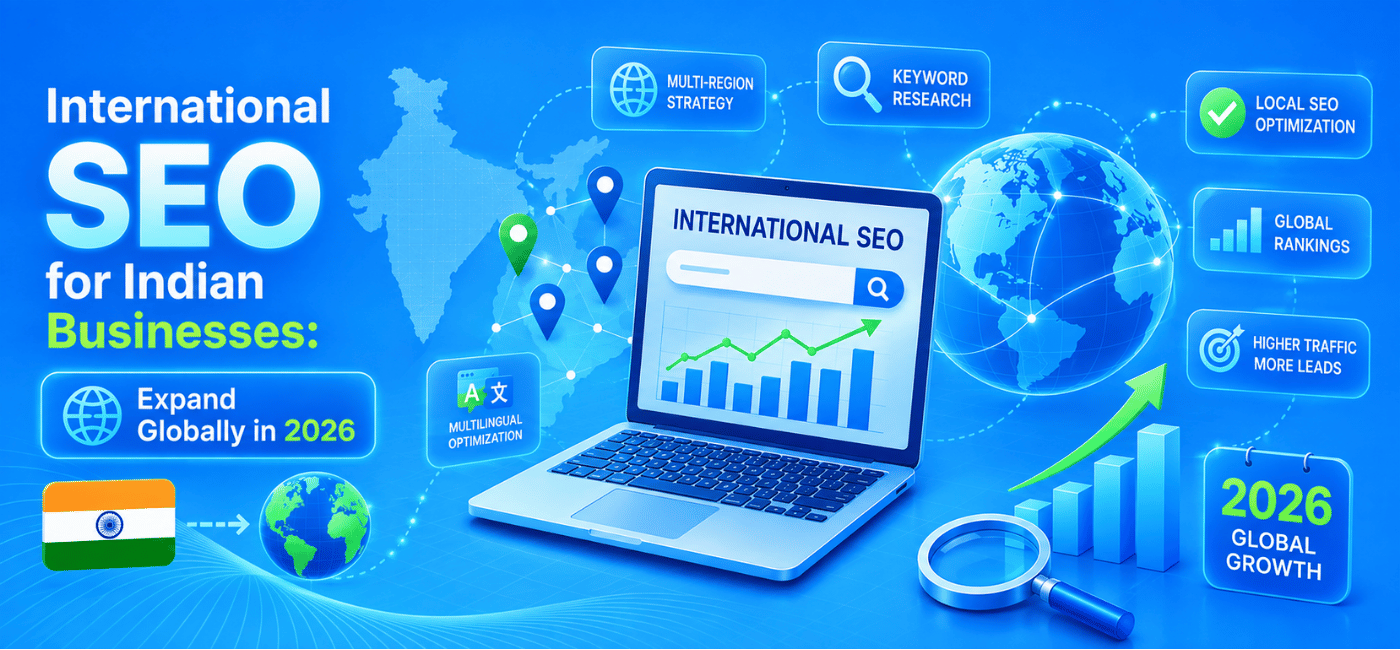
If your company is ready to sell beyond India, International SEO for Indian businesses is one of the most practical ways to build global visibility. It helps your website rank in other countries, attract the right audience, and support growth without depending only on paid campaigns.
The challenge is that global SEO is not just translation. It needs country-specific keyword research, localized content, technical structure, and a clear market strategy so each region sees the right version of your site.
Table of Contents
- What international SEO means
- Why Indian businesses need it
- Choose the right website structure
- Research global keywords
- Localize content for each market
- Set up hreflang correctly
- Build authority in target countries
- Track performance by market
- Common mistakes to avoid
- FAQs
- Conclusion
- CTA
What international SEO means
International SEO is the process of optimizing your website so it can rank in multiple countries and languages. It helps search engines understand which page should appear for which audience.
For Indian businesses, this often means creating region-specific versions of product pages, service pages, and content so global users see the most relevant experience. That may include different currencies, local language, shipping details, or even separate country folders.
Why it matters
Many Indian businesses already have the skills to compete globally. The missing piece is visibility. International SEO helps you reach buyers in the US, UK, Gulf countries, Europe, and other markets where your products or services may already be a fit.
It is especially useful for:
- Export businesses.
- SaaS companies.
- Manufacturers.
- D2C brands.
- Education and consulting firms.
- IT and digital service providers.
If your brand is still building its online identity, the broader positioning on NP Creations’ homepage and About Us page can help establish the kind of credibility global buyers expect.
Choose the right structure
Your site structure affects how well search engines and users understand your global versions. Common options include country subfolders, subdomains, or separate ccTLDs.
Common options
- Country folders: example.com/uk/
- Subdomains: uk.example.com
- Country domains: example.co.uk
For many businesses, folders are the simplest starting point because they are easier to manage and scale. Larger enterprises may choose separate domains when they need strong local market separation.
Research global keywords
Do not assume a keyword that works in India will work the same way in another country. Search intent, vocabulary, and product expectations can change by market.
Use these methods:
- Set country targeting in keyword research tools.
- Review local competitor pages.
- Study search terms used in target markets.
- Talk to local teams or distributors.
- Check how customers describe the same product in different countries.
For example, a buyer in one country may search by product category while another searches by use case. That small difference can change your traffic quality significantly.
Localize content properly
Localization is not just translation. It means adapting your pages to the market so they feel native and trustworthy.
Localize:
- Prices into local currency.
- Shipping and delivery details.
- Return policies.
- Cultural references.
- Customer testimonials from the region.
- Seasonal offers and holidays.
A page for the Gulf market should not read exactly like an Indian landing page. The user experience, trust signals, and copy should feel relevant to that region.
Set up hreflang
Hreflang tells search engines which page version belongs to which country or language. This is one of the most important technical steps in international SEO.
Without it, Google may show the wrong page to the wrong audience. That can hurt engagement and create duplicate-content confusion.
Best practices:
- Map every regional version.
- Keep language-country combinations consistent.
- Test implementation after launch.
- Make sure canonical tags and hreflang do not conflict.
If you need stronger technical execution across multiple service pages, NP Creations’ International SEO services are a relevant internal reference.npcreations
Build authority in each market
Links and mentions from local websites matter because they signal relevance in that specific country. A backlink from a trusted local publication in your target market can carry more value than a random global mention.linkedin+1
Ways to build local authority:
- Get listed on local business directories.
- Publish guest content on country-specific sites.
- Earn mentions from regional industry associations.
- Work with local partners and distributors.
- Translate press releases for local media.
For service brands scaling with stronger acquisition systems, NP Creations’ AI SEO services can help support research, content planning, and optimization at scale.npcreations
Track performance by market
Global SEO should never be measured as one single bucket. Each market should be tracked separately so you can see what is working and where the gaps are.
Track:
- Traffic by country.
- Rankings by target market.
- Conversions by region.
- Bounce rate by page version.
- Leads or sales by market.
- Indexed pages per country.
This helps you decide where to invest more. A strong market may justify more content, while a weak one may need technical or localization fixes first.
Common mistakes
A lot of international SEO projects fail because the strategy is too shallow. Many teams translate pages but never localize them properly.
Avoid these mistakes:
- Using one generic page for all countries.
- Skipping hreflang.
- Ignoring local keyword differences.
- Keeping the same messaging across markets.
- Targeting too many countries too soon.
- Forgetting to track performance by region.
If your site is built for ecommerce, a strong technical and content foundation like the one used in NP Creations’ Shopify SEO services can be especially useful for global product scaling.
90-day launch plan
A simple rollout plan can keep the project manageable.
First 30 days
- Choose your first target country.
- Finalize site structure.
- Map keywords.
- Audit technical issues.
- Plan page versions.
Days 31–60
- Publish localized pages.
- Add hreflang.
- Translate or adapt content.
- Add local trust signals.
- Fix any duplicate issues.
Days 61–90
- Build local links.
- Launch country-specific content.
- Track rankings and conversions.
- Improve pages based on data.
If your business is still refining its broader digital strategy, NP Creations’ digital marketing agency Bangalore page can offer another useful example of how service positioning is presented for market-specific growth.npcreations
Example
A manufacturing company in India selling industrial parts to the UK can create a UK-specific folder with local pricing, delivery terms, and usage language. The Indian version can stay focused on local buyers, while the UK version targets British search intent. That separation makes both versions stronger.
FAQs
1. What is International SEO for Indian businesses?
It is the process of optimizing a website so it can rank and convert in multiple countries and languages.linkedin+2
2. Is translation enough for global SEO?
No. You also need localization, country targeting, hreflang, local keywords, and market-specific trust signals.bitsi+1
3. Which site structure is best for international SEO?
Folders are often the easiest to manage, but the best choice depends on your business size, market count, and technical setup.linkedin+1
4. Why is hreflang so important?
Hreflang helps search engines show the correct page version to the correct audience, reducing confusion and duplicate signals.sunilpratapsingh+1
5. Should Indian businesses target one country first?
Yes. It is usually better to launch in one market first, learn from the results, and then expand to the next region.linkedin+1
6. Can SEO help export or service businesses expand globally?
Absolutely. International SEO is especially valuable for exporters, SaaS brands, consulting firms, and service companies entering new markets.vedamvision+1
7. Do I need expert help for international SEO?
Yes, if you are managing multiple regions, languages, or technical requirements. Expert support can prevent costly mistakes and speed up growth.
Conclusion
International SEO gives Indian businesses a structured way to grow beyond domestic markets. When you combine the right site structure, localization, hreflang, and country-specific strategy, your brand becomes easier to find and easier to trust across borders.
The companies that win globally are usually the ones that start with one market, execute well, and scale carefully. That approach is far more effective than trying to target every country at once.
Call-to-Action
If you want help building a global search strategy, NP Creations can support you with SEO strategy, content, and technical execution through its blog, International SEO services, and AI SEO services