























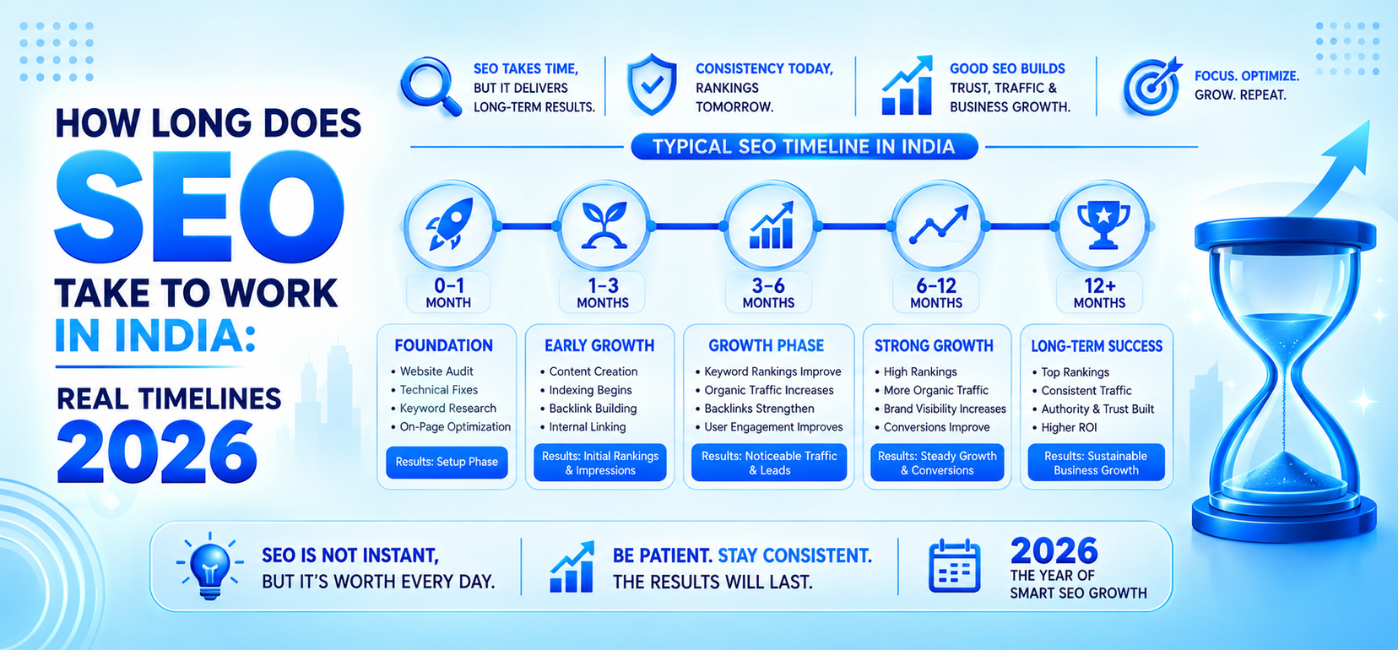
If you have recently started SEO, you may be asking: How long does SEO take to work India businesses actually see results from?
The realistic answer is that most websites begin showing measurable movement within 3 to 6 months, while stronger traffic growth, qualified leads, and meaningful ROI often take 6 to 12 months. Highly competitive industries, new domains, ecommerce websites, and national keywords can take longer.
SEO is not instant because search engines need time to crawl your pages, understand the content, compare it with competitors, test its relevance, and evaluate user and authority signals. The goal is not simply to improve rankings for a few keywords. The goal is to build a reliable source of qualified traffic that continues growing over time.
This guide explains what happens month by month, which factors influence the timeline, what results you should expect, and how to identify real SEO progress before rankings reach the first page.
Table of Contents
- The short answer
- Why SEO takes time
- SEO timeline month by month
- Timelines by business type
- What affects SEO speed
- New website vs established website
- Local SEO timeline in India
- Ecommerce SEO timeline
- B2B SEO timeline
- National and competitive SEO timeline
- How to know SEO is working
- How to speed up SEO safely
- Red flags and unrealistic promises
- FAQs
- Conclusion and CTA
The Short Answer
Most businesses in India should expect:
| SEO result | Typical timeline |
| Technical fixes and improved crawlability | 2–8 weeks |
| More impressions and keyword movement | 1–3 months |
| Early traffic improvements | 3–6 months |
| Initial qualified leads from organic search | 4–8 months |
| Stronger traffic and commercial rankings | 6–12 months |
| Compounding SEO ROI | 9–18 months or more |
These ranges are not guaranteed. A local plumber in a low-competition city may see visibility sooner than a new ecommerce brand trying to rank nationally for highly competitive product categories.
Shopify’s SEO guidance notes that measurable SEO results typically take 3 to 6 months, while highly competitive verticals may require 12 months or more. Multiple 2026 India-focused sources similarly describe early movement in the 3-to-6-month period and stronger compounding results over 6 to 12 months.
Why SEO Takes Time
SEO takes time because ranking is not based on one action. Search engines evaluate many signals before deciding where a page deserves to appear.
A website must demonstrate:
- Crawlability.
- Indexability.
- Technical health.
- Search intent match.
- Helpful and original content.
- Page relevance.
- Internal linking.
- Mobile usability.
- Loading performance.
- Website authority.
- Brand trust.
- External mentions and backlinks.
- User satisfaction.
Even after you publish or improve a page, Google needs to crawl the update, process it, compare it with competing pages, and assess whether it provides a better result for users.
SEO also compounds. One optimized page may help another page through internal links, topical relevance, brand visibility, and user engagement. That compounding effect is why the strongest results often come later rather than in the first month.
SEO Timeline Month by Month
Month 1: Audit, tracking, and technical foundation
The first month should focus on understanding the website before trying to scale content.
Typical tasks include:
- Technical SEO audit.
- Google Search Console review.
- Analytics and conversion tracking setup.
- Keyword research.
- Competitor analysis.
- Indexing review.
- Metadata audit.
- Internal-linking review.
- Page-speed review.
- Content-gap analysis.
- SEO roadmap creation.
You may not see major ranking changes during this stage. That does not mean SEO is failing. It means the groundwork is being built.
Month 2: Fix major SEO issues
During the second month, teams often start implementing technical and on-page improvements.
Common work includes:
- Fixing crawl errors.
- Updating title tags and meta descriptions.
- Improving service or product pages.
- Correcting noindex and canonical issues.
- Improving site structure.
- Adding internal links.
- Fixing broken links and redirects.
- Improving mobile usability.
- Publishing the first optimized content pieces.
At this stage, Google may start recrawling updated pages. You may notice impressions rising before clicks increase.
Month 3: Early signs of movement
By month three, some businesses begin seeing progress in Google Search Console.
Possible signals include:
- More indexed pages.
- Higher impressions.
- Rankings for long-tail keywords.
- Improved visibility for low-competition terms.
- Better click-through rates from improved titles.
- More pages appear in search.
- Early local pack movement.
- Small traffic gains.
For many websites, these are early proof points—not the final outcome. India-focused SEO timelines commonly place early measurable movement around months 3 to 4.
Months 4–6: Traffic and ranking traction
This is often where SEO starts becoming more visible.
You may begin to see:
- Better rankings for target pages.
- More non-branded traffic.
- Improved long-tail keyword visibility.
- Initial enquiries or calls.
- More local map visibility.
- Higher organic clicks.
- Better performance from recently published content.
- Growing page-one or page-two positions.
For a healthy campaign, months 3 to 6 are usually when early organic gains become measurable. Shopify and several 2026 SEO sources place this period as the first realistic window for meaningful ranking and traffic progress.
Months 6–12: Compounding business results
Once the technical foundation, content, internal linking, and authority work begin reinforcing each other, stronger results can emerge.
Possible outcomes include:
- More page-one rankings.
- Greater non-branded traffic.
- Consistent organic leads.
- Improved conversion performance.
- More visibility for commercial keywords.
- Better local map presence.
- Higher organic revenue.
- Lower reliance on paid advertising.
- Stronger brand searches.
For many businesses, this is when SEO starts generating a clearer business case. However, difficult industries may still be building momentum at this stage.
Timelines by Business Type
SEO timelines vary by business model and competition.
| Business type | Early movement | Meaningful results | Why |
| Local service business | 3–6 months | 6–9 months | Local targeting can be narrower, but reviews and competition matter |
| Small business website | 3–6 months | 6–12 months | Depends on local competition and website quality |
| B2B company | 4–6 months | 6–12+ months | Longer buying cycles and competitive commercial terms |
| Ecommerce store | 4–6 months | 6–12+ months | Product competition, catalog size, and technical complexity |
| SaaS business | 4–8 months | 9–18 months | Competitive content, authority, and longer sales cycles |
| National brand | 6–9 months | 9–18+ months | Broader competition and more authority required |
| New domain | 6–12 months | 12+ months | Limited history, content, and trust signals |
| International SEO | 6–12 months | 12–18+ months | Localization, technical setup, and country-level authority required |
These are broad planning ranges. A local business with a strong existing reputation may progress faster than a new website in a low-competition niche. A new ecommerce store in fashion or beauty may take longer because competition is high.
New Website vs Established Website
A new website generally needs more time because it has little history, limited content, few backlinks, and no established trust.
New website
A new site often needs to build:
- Indexation.
- Relevant content.
- Internal structure.
- Brand signals.
- External mentions.
- User engagement.
- Trust.
A realistic expectation for a new website is early keyword movement in several months and more meaningful traffic growth in 6 to 12 months or longer.
Established website
An established site may move faster if it already has:
- A strong domain history.
- Existing backlinks.
- Relevant content.
- Indexed pages.
- Brand recognition.
- Technical health.
- Search Console data.
However, an old website with poor technical setup, thin content, or outdated architecture may still need extensive foundational work.
Local SEO Timeline in India
Local SEO can produce earlier results than national SEO because the search area is narrower. But results still depend on city competition, business category, Google Business Profile quality, reviews, local citations, and website relevance.
Typical local SEO improvements include:
- Google Business Profile optimization.
- Local keyword targeting.
- Location pages.
- Customer reviews.
- Citation consistency.
- Local backlinks and mentions.
- Mobile usability.
- Local service-page improvements.
A low-competition local business may see initial progress in 3 to 6 months. Highly competitive local categories such as healthcare, legal services, restaurants, real estate, education, and home services may require 6 to 12 months or more. Local SEO services focus on local keyword targeting, Google Business Profile optimization, location-focused content, and helping businesses attract nearby customers.
Ecommerce SEO Timeline
Ecommerce SEO often takes longer because stores have many moving parts.
The timeline depends on:
- Number of products.
- Number of categories.
- Product demand.
- Technical platform.
- Site speed.
- Duplicate content.
- Product schema.
- Out-of-stock handling.
- Collection-page quality.
- Brand authority.
- Competition.
An ecommerce site may begin to see early technical and long-tail gains in 3 to 6 months. However, competitive product categories often need 6 to 12 months or more for significant organic revenue growth.
For Shopify stores, SEO work may include product-page optimization, collection-page strategy, schema, internal linking, site-speed improvements, content, and technical audits. Shopify SEO services are designed to improve relevant rankings, qualified traffic, and sales performance.
B2B SEO Timeline
B2B SEO often has a longer path to visible revenue because buyers research, compare, and involve multiple decision-makers before making a purchase.
A B2B SEO campaign may need:
- Industry-specific service pages.
- Buyer-intent keyword targeting.
- Thought-leadership content.
- Comparison pages.
- Case studies.
- Lead magnets.
- Conversion-focused landing pages.
- Sales and CRM tracking.
- Authority-building work.
You may see organic traffic first, but qualified pipeline can take longer because B2B sales cycles are often measured in weeks or months.
B2B SEO services focus on attracting qualified traffic and high-value leads in competitive B2B markets.
National and Competitive SEO Timeline
National SEO is more competitive because you are not competing only with local businesses. You may be competing with established brands, publishers, marketplaces, comparison sites, and companies with years of content and backlink history.
Highly competitive sectors include:
- Finance.
- Insurance.
- Real estate.
- Healthcare.
- Legal services.
- Education.
- Travel.
- Ecommerce.
- Software.
- Digital marketing.
In these markets, 9 to 18 months may be more realistic for serious commercial visibility. Some very competitive or regulated categories can take longer.
The key is consistent work. Stopping SEO after three months often means stopping just before the work begins to compound.
How to Know SEO Is Working
Rankings are useful, but they are not the only sign of SEO progress.
Early indicators
Look for:
- More pages being indexed.
- Increased impressions in Search Console.
- More ranking keywords.
- Better positions for long-tail terms.
- Higher click-through rates.
- Fewer crawl errors.
- Improved Core Web Vitals.
- Stronger internal-link coverage.
- More branded searches.
- Better local profile actions.
Business indicators
Over time, track:
- Organic clicks.
- Organic leads.
- Calls from organic traffic.
- Form submissions.
- Appointment bookings.
- Organic revenue.
- Ecommerce purchases.
- Qualified leads.
- Cost per acquisition.
- Sales opportunities influenced by organic search.
The right measure depends on the business. A B2B company may care most about qualified demo requests. An ecommerce store may focus on organic revenue and add-to-cart rate. A local clinic may care about calls and appointment bookings.
How to Speed Up SEO Safely
You cannot force Google to rank a weak page quickly, but you can avoid delays and improve the chance of faster progress.
Focus on high-impact actions
- Fix crawl and indexation problems.
- Improve high-value service and product pages.
- Target realistic long-tail keywords first.
- Publish original, useful content.
- Strengthen internal linking.
- Improve mobile performance.
- Optimize titles and meta descriptions.
- Earn relevant mentions and backlinks.
- Build and manage your Google Business Profile.
- Track conversions from the beginning.
- Update older content that already has impressions.
Avoid shortcuts
Avoid:
- Buying bulk backlinks.
- Publishing copied content.
- Keyword stuffing.
- Creating doorway pages.
- Hiding text.
- Using fake reviews.
- Publishing hundreds of thin AI-generated pages.
- Promising impossible ranking timelines.
Shortcuts may create short-term movement, but they can weaken long-term performance and create expensive cleanup work.
For businesses that want a faster, more structured SEO workflow, AI SEO services combine AI-driven research and optimization with strategies designed to improve qualified traffic and conversion performance.
Red Flags and Unrealistic Promises
Be cautious when an agency or freelancer promises:
- Number-one rankings in 30 days.
- Guaranteed traffic without reviewing your site.
- Thousands of backlinks every month.
- Instant results in highly competitive industries.
- A fixed ranking position for every keyword.
- No need for content or technical improvements.
- SEO without access to Search Console or analytics.
- No reporting on leads or revenue.
A reliable SEO partner should explain the work, timeline, expected milestones, risks, and how success will be measured.
SEO requires patience, but it should not feel vague. You should receive clear priorities, completed tasks, performance reports, and explanations of what is improving.
Frequently Asked Questions
1. How long does SEO take to work India businesses can realistically expect?
Most businesses start seeing measurable movement in 3 to 6 months. More meaningful traffic, leads, and ROI commonly develop over 6 to 12 months. Competitive industries, new websites, and national keywords can take longer.
2. Can SEO show results in one month?
You may see technical fixes, improved indexation, better titles, and early impression changes in the first month. However, meaningful rankings, traffic, and leads generally need more time.
3. How long does local SEO take in India?
Local SEO may show early progress in 3 to 6 months, especially in lower-competition markets. Competitive cities and industries often need 6 to 12 months of consistent work.
4. Why is my SEO not working after three months?
Three months may only be enough to complete audits, technical fixes, on-page optimization, and early content work. Review whether pages are indexed, impressions are improving, technical issues are fixed, and the strategy targets realistic keywords.
5. Does SEO take longer for new websites?
Usually, yes. New domains need time to build content, authority, trust, and search history. Many new sites need 6 to 12 months or more for meaningful organic growth.
6. How long does ecommerce SEO take?
Ecommerce stores often see early movement in 3 to 6 months, but meaningful organic revenue growth in competitive categories may take 6 to 12 months or longer.
7. Can AI make SEO results faster?
AI can speed up research, content planning, technical analysis, and reporting. However, it cannot replace useful content, technical implementation, authority building, or the time search engines need to evaluate a website.
Conclusion
SEO is a long-term investment, not an instant advertising channel. For most businesses in India, initial signs of progress appear within 3 to 6 months, while stronger traffic, leads, and ROI develop over 6 to 12 months or more.
The timeline depends on your starting point, competition, website quality, content, authority, and consistency. Local businesses may move faster than national brands, while new websites and competitive ecommerce categories often require more patience.
The best SEO programs focus on steady progress: fixing the technical foundation, publishing useful content, improving high-value pages, building authority, and measuring the leads or revenue that organic search creates.
Call to Action
Want a realistic SEO roadmap based on your website, competition, and growth goals? Explore NP Creations AI SEO services for research-led strategy, content optimization, technical SEO, and qualified-traffic growth support. For local businesses that want more calls, map visibility, and nearby leads, explore local SEO services.