

























So you’ve decided to start a Shopify store. Great. Maybe you’ve already picked a product, maybe you’re still figuring out the niche — either way, at some point you’re going to hit that “go live” button and hope for the best. Most people skip half the stuff that matters. Then they wonder why their store isn’t converting.
This isn’t one of those generic checklists you find everywhere. This is specifically for launching in India, where payment gateways behave differently, shipping logistics have their own quirks, and your customer is probably browsing on a ₹12,000 Android phone with patchy 4G. Context matters a lot here.
I’ve seen enough Shopify stores — some done really well, many done in a rush — to know what gets missed. Let’s just go through it properly.
1. Get Your Foundation Right Before Anything Else
Before touching design or products, there are some basics that need to be in place. This is the boring stuff but honestly it determines everything downstream.
Business & Legal Setup
Register your business — even a sole proprietorship works to start. You’ll need a GST number if your turnover crosses ₹20 lakhs (or ₹10 lakhs in special category states), but honestly, get it early. Most payment gateways ask for it. And customers in India, especially B2B buyers, actually look for GST invoices. It builds trust weirdly fast.
You also need a current account, not a savings account, for your business transactions. Yes it’s a bit of paperwork. Yes it’s worth it.
Domain & Hosting
Get a custom domain. The yourstore.myshopify.com URL looks unfinished and people notice. A .com is ideal, .in works fine too if you’re targeting Indian customers primarily. GoDaddy, Namecheap, BigRock — pick any. Keep it short, easy to spell, hard to typo.
2. Shopify Store Setup India — The Core Configuration
This is where most people spend time, and rightly so. But there’s a specific order to do things that saves you from redoing work later.
Choose a Theme That Actually Loads Fast
Shopify has free themes — Dawn is solid, minimal, and fast. Don’t go with heavy premium themes just because they look fancy in the preview. Page speed matters enormously in India. A store that takes 6 seconds to load on mobile is basically invisible — people just leave. Google PageSpeed score should be your north star here, not how many animations you can fit on the homepage.
If you’re working with a Shopify development company in India, ask them specifically about Core Web Vitals performance before signing off on any design. It’s a fair ask and a good one.
Set Up Your Store Currency, Time Zone & Tax Settings
Set everything to India — INR currency, IST timezone, and configure Indian tax rates (IGST/CGST/SGST depending on your state). Shopify doesn’t automatically know all this. You have to go in and set it. Missing tax config can create accounting headaches later that are genuinely painful to fix retroactively.
Navigation & Site Structure
Keep it simple. Main menu: Home, Shop (or Collections), About, Contact. That’s it to start. You can add more later. A cluttered nav is one of those small things that confuses people more than you’d expect.
3. Products, Pricing & Descriptions
Don’t list products in a hurry—especially in ecommerce website development India, where competition is high and users are quick to judge. Rushed product pages are obvious, and they don’t convert.
Product Photography
Clean, well-lit images matter. Use white or neutral backgrounds for primary shots and lifestyle images for context. You don’t need a fancy studio—a good phone camera and even a ₹500 white cardboard backdrop from Amazon can genuinely do the job. Multiple angles matter. If possible, show the product in use so customers can visualize it better.
Writing Product Descriptions That Actually Work
Skip the “premium quality, best product” filler text—nobody believes it. Instead, clearly explain what the product does, who it’s for, and what problem it solves. Include size guides where relevant, material details, and honest, useful information. That’s what builds trust.
Also, Indian customers read descriptions more carefully than many assume, especially for products priced above ₹500. They are price-conscious and want to feel informed before making a purchase. In the competitive space of ecommerce website development India, earning that trust through clear and transparent copy can directly impact conversions.
Pricing for the Indian Market
Round numbers tend to perform better. ₹999 often outperforms ₹1,000, while ₹1,199 can sometimes feel random or less trustworthy. Think about how your pricing feels psychologically. Showing an MRP with a crossed-out price also works well—this “discount” cue is highly effective across Indian ecommerce categories.
4. Payment Gateway Setup — This One’s Critical
Indian payment gateway setup is genuinely different from what you’d do in the US or UK. Shopify Payments isn’t available in India — so you need a third-party option.
Which Payment Gateway to Use
Razorpay is probably the most popular for Shopify stores in India right now. It supports UPI, credit/debit cards, net banking, EMI, and wallets — basically every Indian payment method your customer might want. PayU is another solid option. Cashfree works well too, especially for smaller brands.
Setting up takes a few days because of KYC verification, so don’t leave this for the last minute before your launch date. Seriously. I’ve heard of launches being delayed by a week just because the payment gateway wasn’t ready.
Cash on Delivery (COD)
Add it. COD still accounts for a significant chunk of ecommerce orders in India, especially in tier 2 and tier 3 cities. Yes, there’s a return risk. But not having it means losing real customers. You can always limit it geographically or for certain order values.
5. Shipping & Logistics — The Part That’ll Actually Make or Break You
Your product can be great. Your store can look perfect. If shipping is slow or unreliable, customers won’t come back. And in India, shipping expectations have been shaped by Flipkart and Amazon, which means people expect fast and tracked delivery.
Pick a Shipping Partner
Shiprocket, Delhivery, Ecom Express — these are the main names. Shiprocket integrates directly with Shopify and aggregates multiple courier partners, which is convenient. Pricing depends on weight and distance zones. If you’re starting small, Shiprocket is probably the easiest entry point.
Define Shipping Zones & Rates Clearly
Set up your shipping zones in Shopify. Free shipping above a threshold works well — ₹499 or ₹599 free shipping is a common benchmark for Indian D2C brands. It also tends to increase average order value because people add things to cart just to hit that threshold.
Communicate estimated delivery timelines on product pages and checkout. 5–7 business days is the usual promise for most Indian logistics partners. Be realistic. Overpromising and underdelivering on shipping is one of the fastest ways to tank your review score.
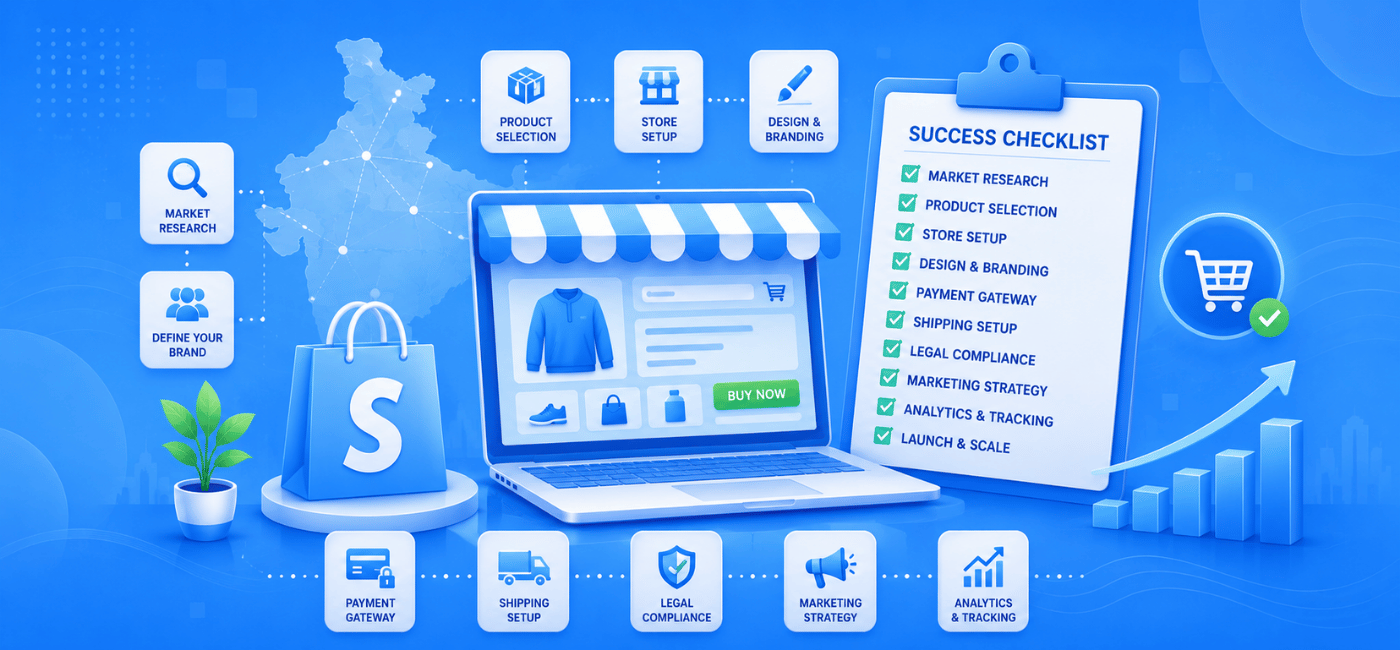
Final Pre-Launch Checklist — Quick Run-Through
Before you actually hit publish, run through this:
- Password removed / store made public
- Custom domain connected and working
- Payment gateway tested with a real transaction
- Checkout flow tested on mobile
- All policy pages live
- Shipping zones configured with correct rates
- COD enabled (if applicable)
- Google Analytics & Search Console connected
- Meta Pixel installed
- Contact page with real info
- Social media profiles live with some content
That’s pretty much it. It’s more than most people do, which is exactly why most stores don’t perform well out of the gate. The ecommerce space in India is growing fast — there’s real opportunity here — but “launching quick and figuring it out later” tends to create bigger problems than just taking an extra week to do it right.
If you’re working with a team or a Shopify development company in India to build your store, share this list with them. A lot of these are their responsibility, but you should still know what to ask for. And if you’re doing it yourself — which honestly many people do — go section by section. You don’t have to do everything in a day.
Good luck with the launch. Hope the first sale comes faster than you expect.